Maestro
Software delivery needs a new operating system.
AI changed how software gets built. It has to change how software gets managed. Maestro brings the work, the decisions, the flow, the metrics, the humans and the AI agents into one system, so you can see what is happening, control what happens next, and know what you can realistically deliver.
A pattern we have seen for decades
Busy is not the same as flowing.
The team is working hard. And still:
Those look like separate problems. They rarely are. They are symptoms of one delivery system that does not flow, and we were diagnosing this pattern long before AI existed.
Then AI raised the stakes
Agents joined the team. The management system did not notice.
Your engineers already deliver alongside AI agents. The tools that manage delivery still assume every unit of work comes from a person: estimates, sprint plans, status meetings, boards somebody updates by hand. That gap is what Maestro closes: one management system where humans and agents work together, and the operation is run as one.
Capacity broke loose from headcount
One engineer now directs several agents working concurrently. Counting people stopped predicting what the operation can deliver.
Cycle times collapsed
Work that took days sometimes lands in hours. A weekly status report is stale before the meeting it was written for.
The expensive part moved
Producing code got cheap. Deciding what to build, in what order, and verifying what comes back is where delivery is won now.
The management problem
A leader should open one screen and know the truth of the operation.
Without asking ten people, assembling a spreadsheet, or calling another status meeting. Maestro exists to answer six questions continuously.
What is happening right now?
Active work, queues, blockers and what just finished render live from the record of the work. Nobody compiles a status report.
What should happen next?
The queue orders itself by business value, risk, and how long work of that size really takes. When a human overrules it, the decision carries a name and a reason.
Are we working on the right things?
Every card carries its why and belongs to a release with a date and an intent. Busy is visible, and so is busy on the wrong thing.
How is the system performing?
Throughput, cycle time, work in progress, aging and rework, measured on work items and agent actions, never on people.
When can we actually deliver?
Forecasts computed from your own history, with probabilities attached, instead of a date somebody typed into a plan three months ago.
Where does a human need to step in?
Decisions wait on named people, impediments say who they are waiting on, and irreversible calls are reserved for humans by written policy.
What you are buying
Visibility. Control. Predictability.
Visibility
The actual state of the operation, drawn from the record of events rather than from what people remember to report.
Control
Written policies govern how work enters and moves: intake through one queue, limits on work in progress, evidence required at done. You govern the system instead of chasing every worker.
Predictability
Delivery dates come from observed performance, with probabilities attached, so commitments become business decisions instead of rituals of estimation.
Powered by orchestration: humans and AI agents working as one operation, with agents held to evidence and people trusted with judgment.
The operating model
Thirty years of delivery practice, encoded into software.
Maestro did not start from a feature list. It started from the Lean Pyramid, the operating model refined over a decade of fixing how software organizations deliver: strategy sets direction, management runs the flow, engineering ships verified value. Maestro runs that model inside the work, so the method arrives with the system instead of sitting in a slide deck.
Humans and AI agents are the workers. Maestro orchestrates the system they work in.
Read the Lean Pyramid canonThe system, on screen
Every screen answers a management question.
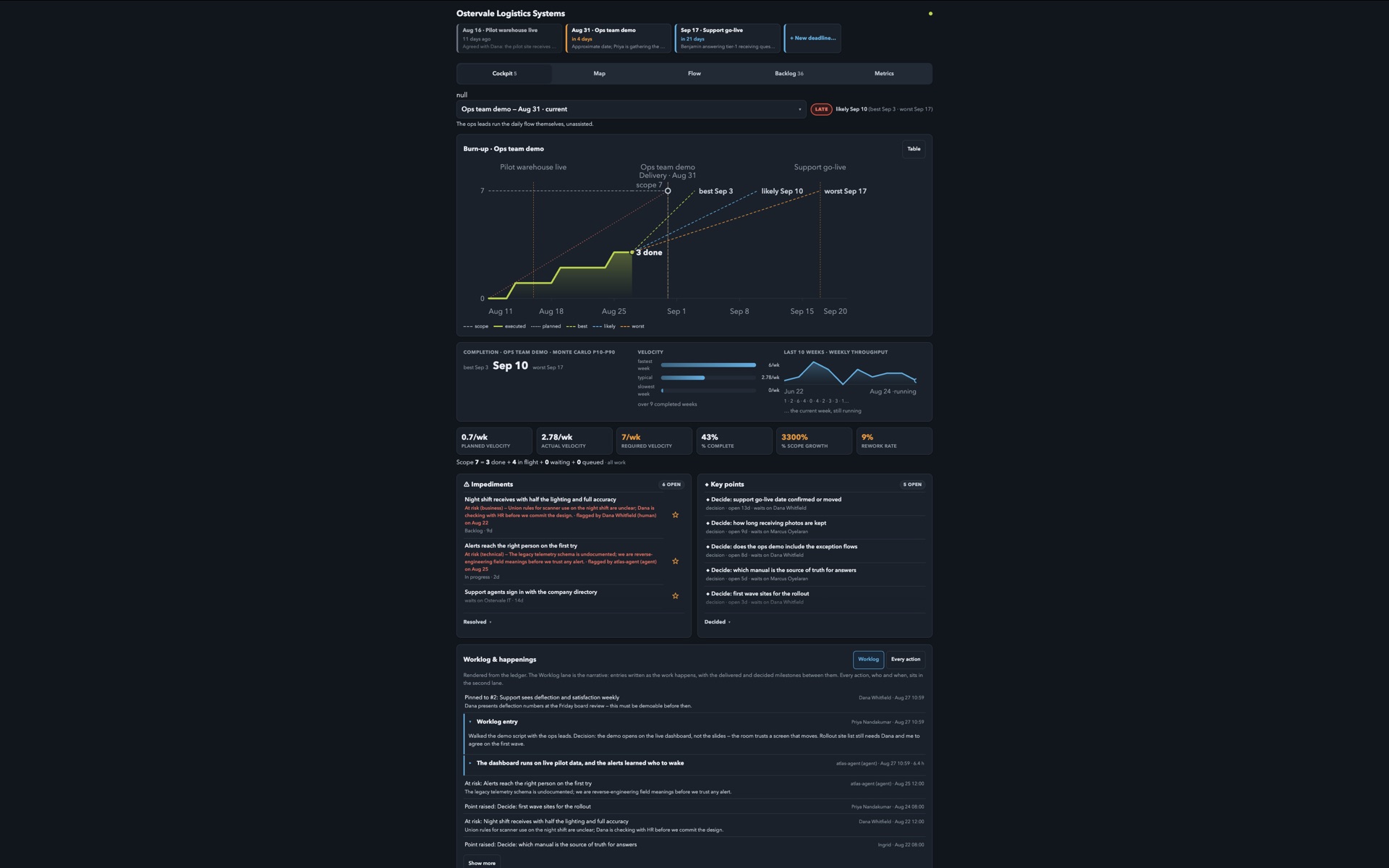
What is happening right now?
Know where everything stands without calling a meeting.
The cockpit: deadlines, the burn-up with its forecast, impediments in the open, decisions waiting on named people. A release running late says so, with best and worst dates.
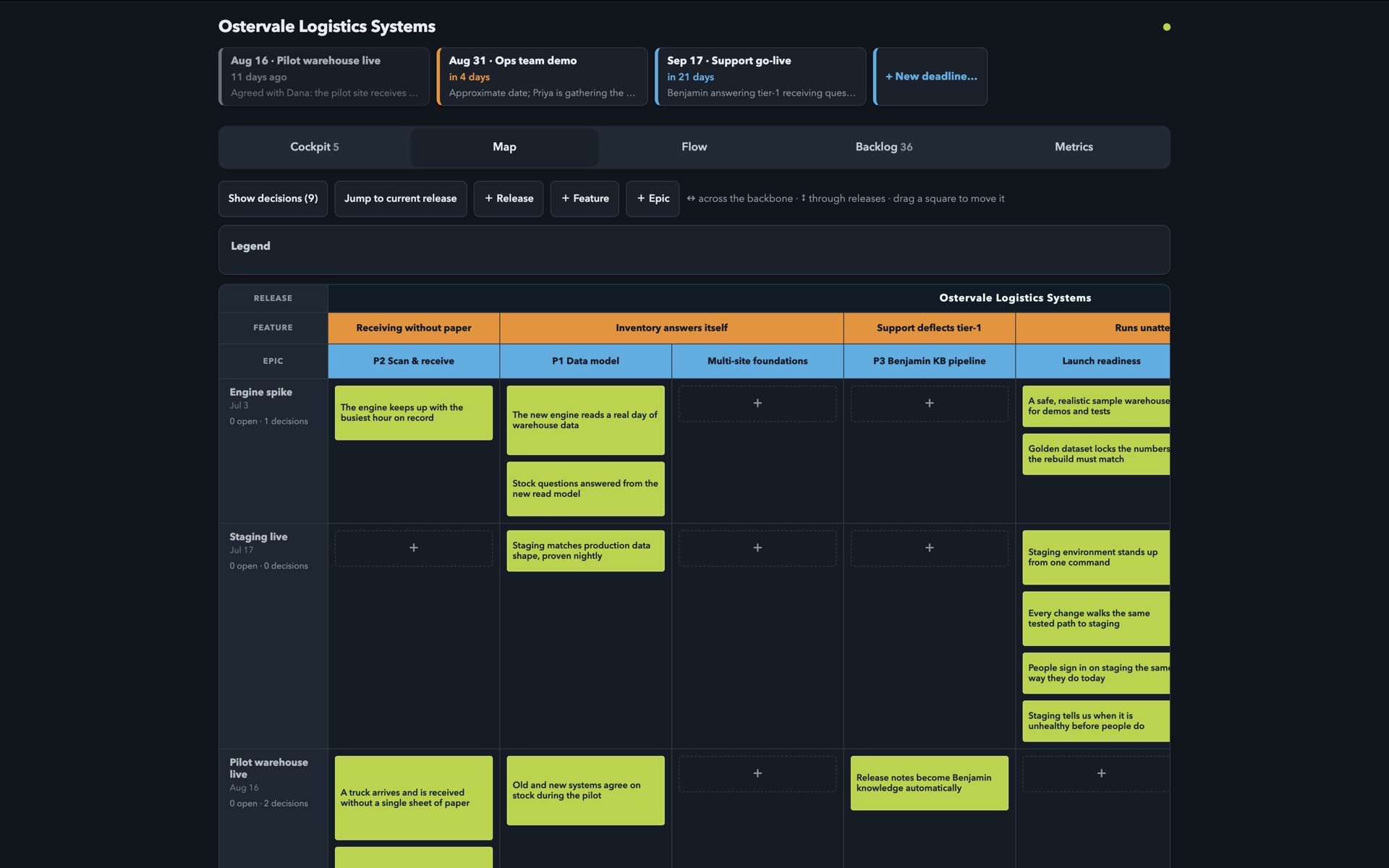
Are we building the right things?
See the whole scope, release by release, on one screen.
The map lays out the whole Delivery Flow: features across the backbone, releases as bands down the side, cards sized XS to XL. Shipped releases sit above, the current one is highlighted, everything else waits below.
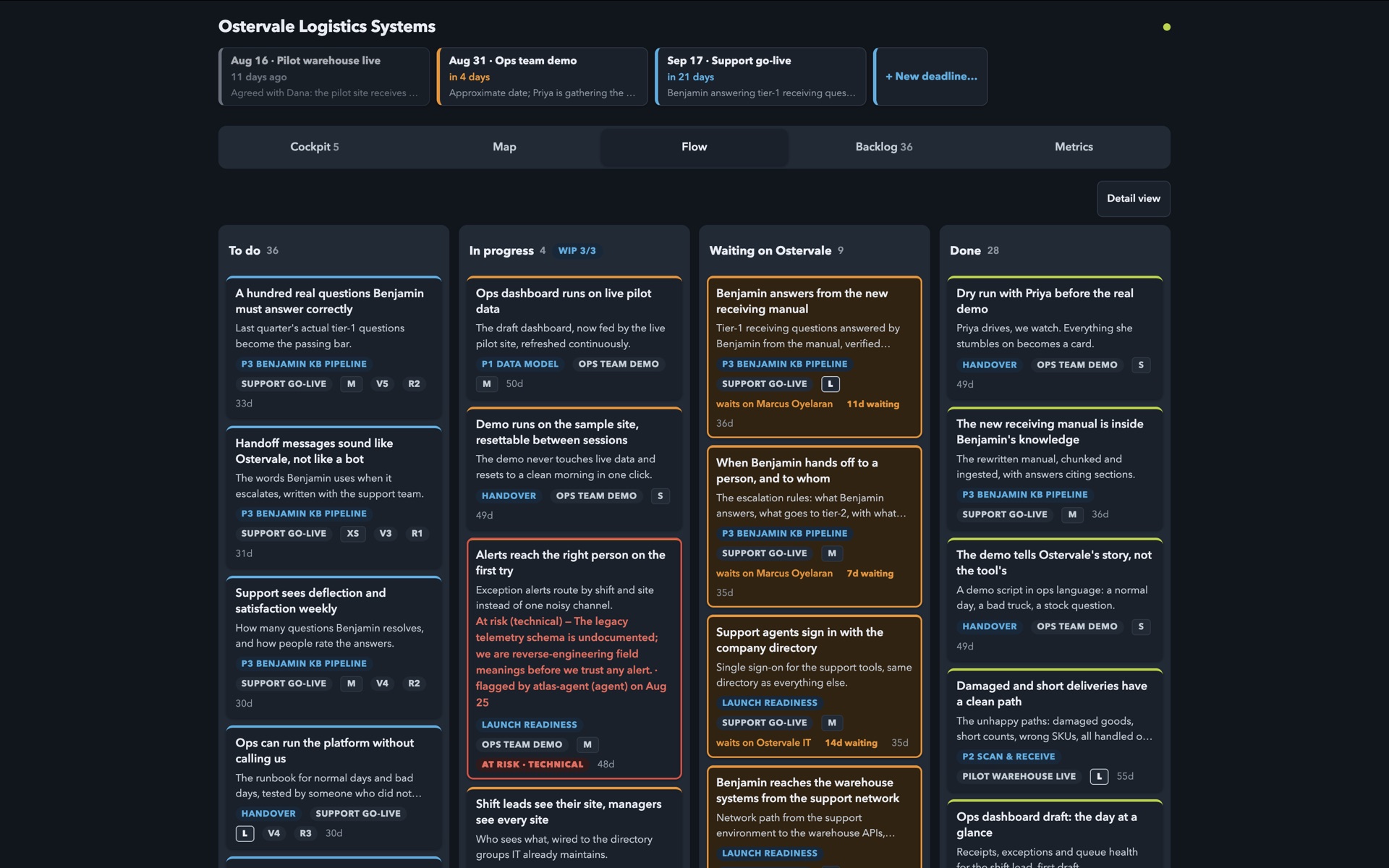
Where is work waiting?
See where work is stuck, and who it is waiting on.
The flow: work in progress under an explicit limit, a lane for what waits on the client with names and days attached, and every card carrying its why. An item at risk says why, in red, with who flagged it.
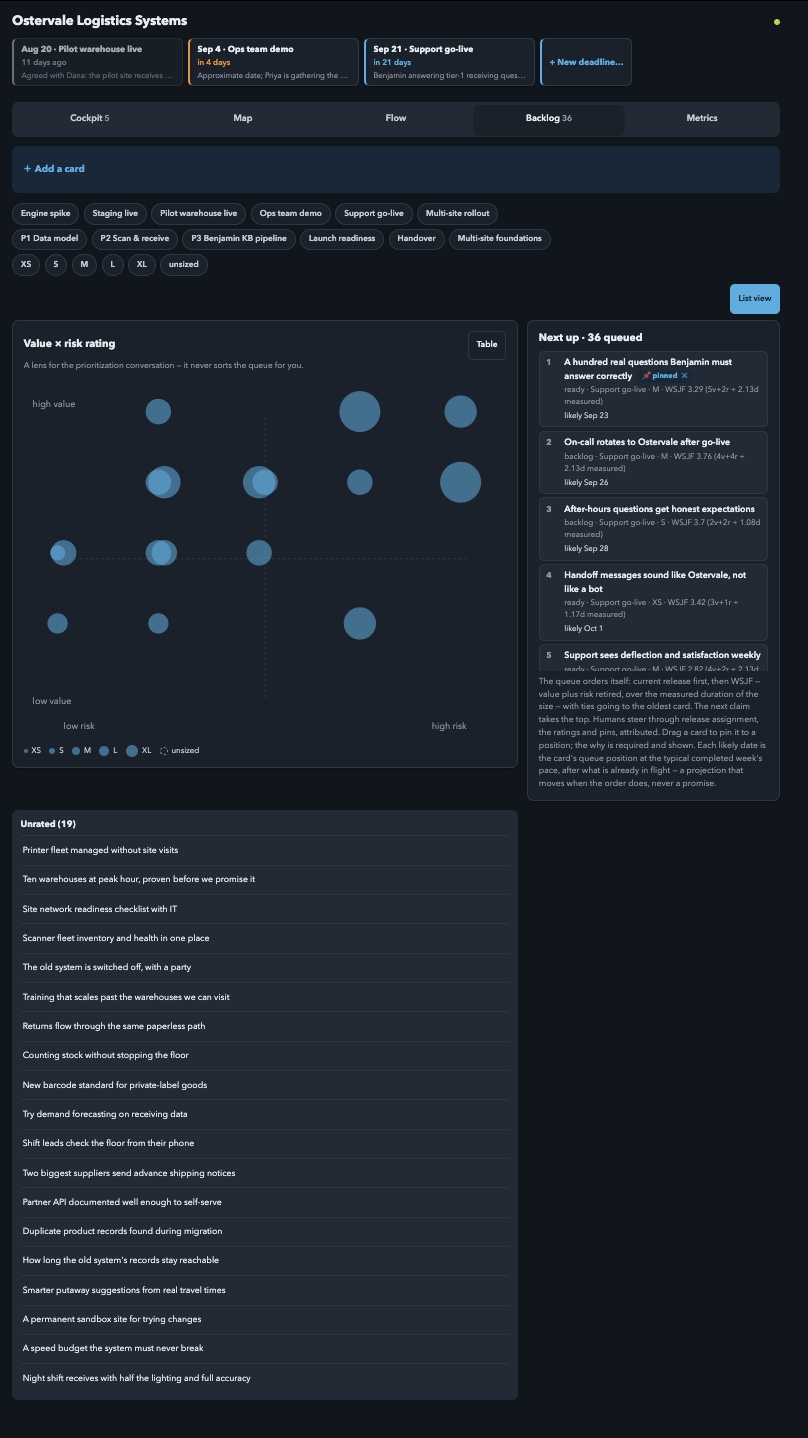
What should happen next?
Know the next most valuable thing to do, and who overruled the queue.
The queue orders itself by value, risk, and how long the work really takes. When a human overrules it, the pin carries their name and their reason.
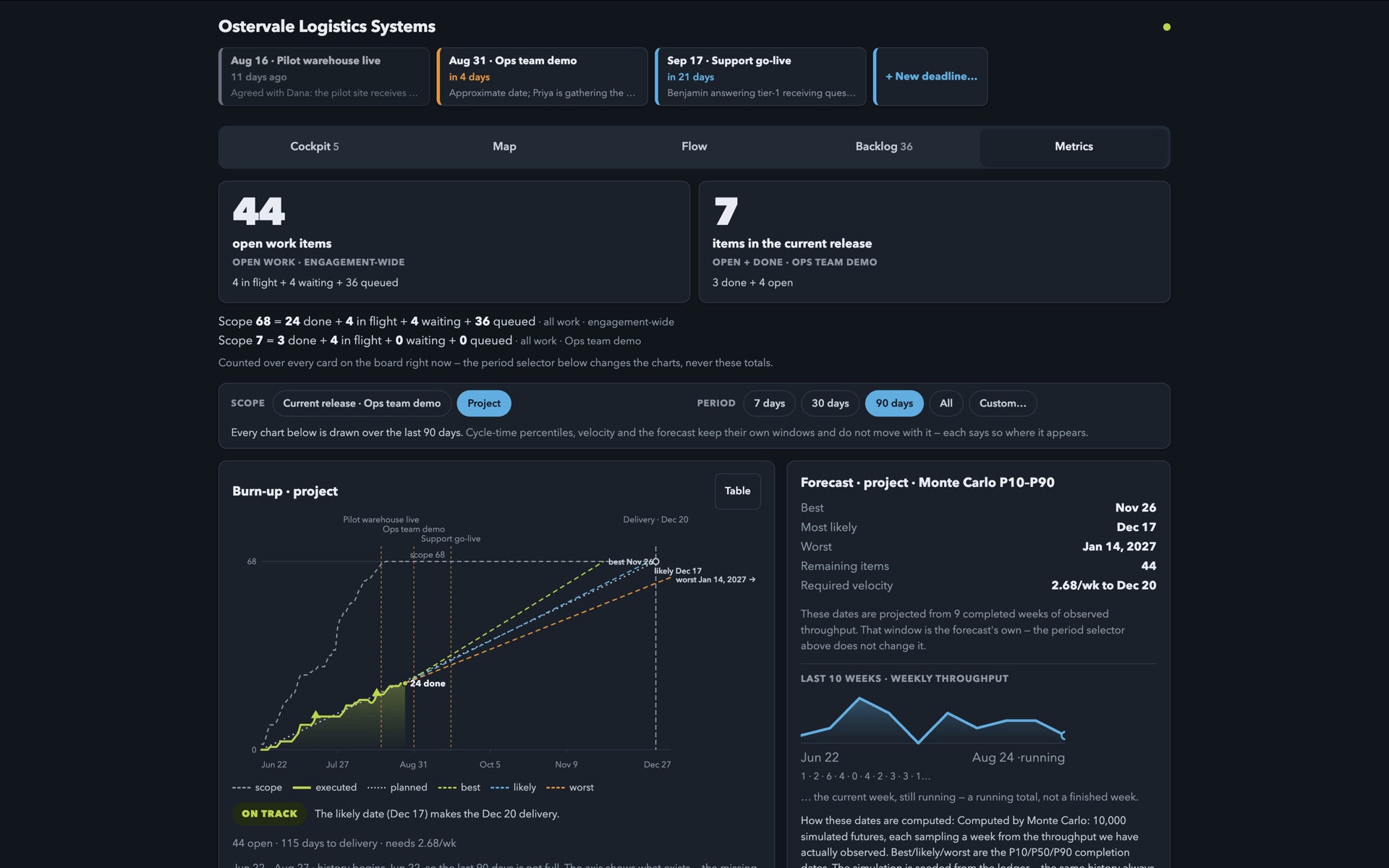
When can we actually deliver?
Know when it will really land, before you promise a date.
The likely date is computed from observed throughput and judged against the delivery date. On track is a computed judgment, and the histogram shows the 10,000 simulated futures behind it.
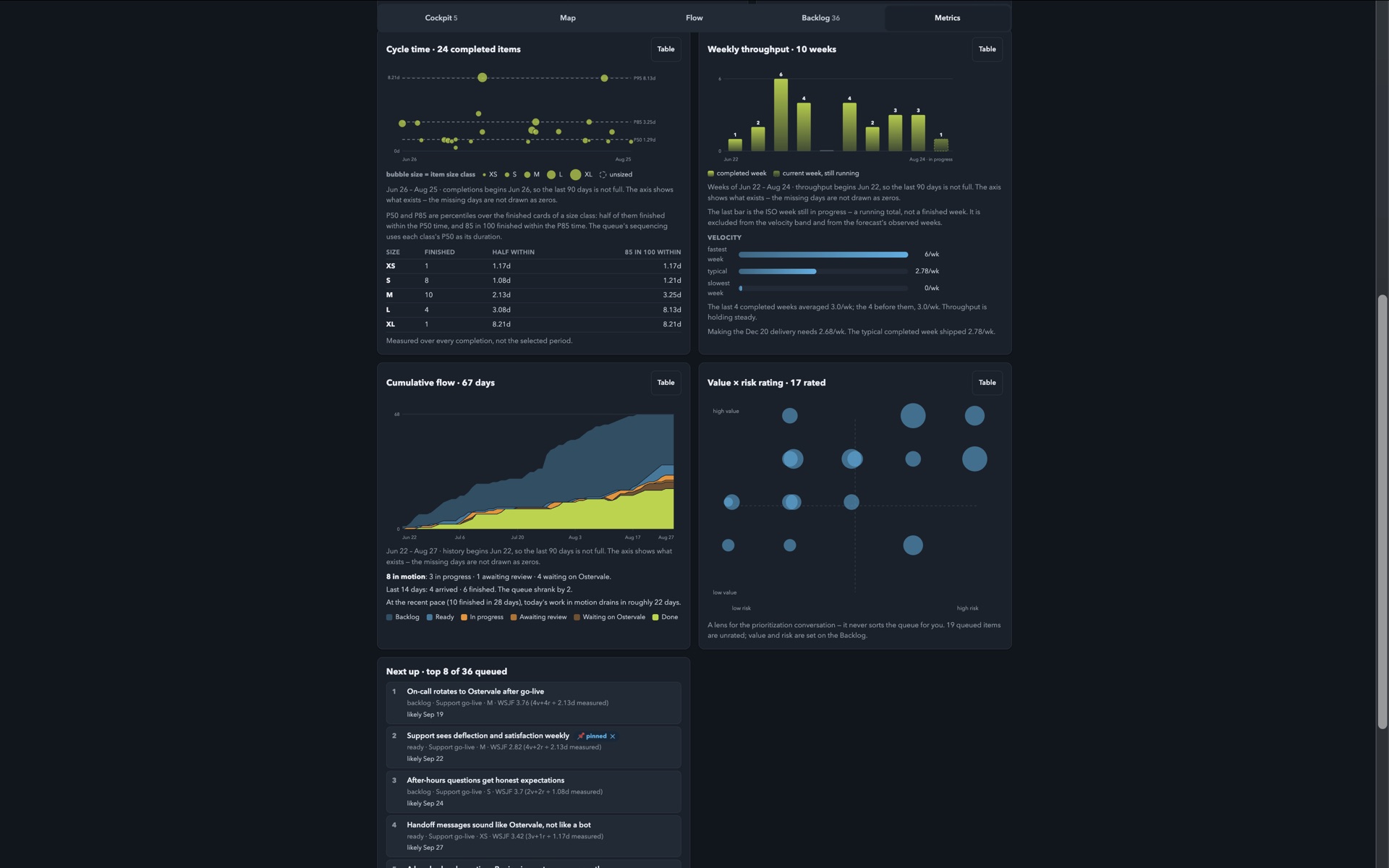
How is the system performing?
Know whether delivery is getting faster or slower before customers feel it.
Cycle time by size class, throughput with velocity bands, cumulative flow, and the queue ordered by value over measured duration. Where history is short, the charts say so.
Beyond tracking
Tracking tools ask people to describe reality. Maestro records it.
In the tools you know, people spend their day describing work to the software: moving cards, updating estimates, preparing reports. In Maestro the board is where the work actually happens, so it is always current: humans and agents move their own work, every move lands in the record, and the reporting takes care of itself. Your people keep their attention on decisions.
Where demand comes from
Agents listen to the work as it happens, meetings, documents, decisions, and turn it into cards on the board. A person reviews and approves.
How agents fit
Agents are workers, never in charge. They follow the same rules people do, and nothing they finish counts until it is proven. Agents get verified. People get trusted.
Where Maestro stands
Maestro is new. The operating model behind it is not. It runs our own client engagements in production today, it opens to partners first, and you can adopt it without a consulting engagement: transformation help exists for when you want the organization redesigned around the system. The fastest demo is the board your own work would run on.
Next step
Start the conversation.
Open a card on our board and get an answer within one business day, or pick a time straight on the calendar.